

National 5 Maths
Bearings in Trigonometry
Our choices for textbooks and tutoring:


Page sections 
- Topic content
- Textbook page numbers
- Key ideas
- Worked examples
- Past paper questions
- Worksheets
- Notes and videos
Topic content
- Use bearings with trigonometry to find a distance or direction
Textbook page numbers
- Zeta National 5+ Maths pp.231-232
- TeeJay Maths Book N5 pp.78, 83 and 88-89
- Leckie National 5 Maths pp.308-311
Buy our favourite textbook
 Zeta National 5+ Maths
Clear and comprehensive.
Progressive exercises.
Includes answers.
Buy from Zeta Press 
Key ideas
- Bearings tell us the direction, on a map, of one point from another.
- Bearings are always measured clockwise from a line pointing north.
- Bearings are usually written as three-figure bearings. For example, 070° means 70°.
- The word 'from' is really important. It tells us where the angle is. For example:
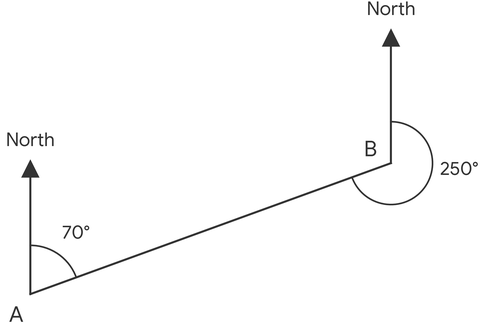
The bearing of B from A is 070°.
The bearing of A from B is 250°.
Note that the difference between 70° and 250° is 180°, a straight angle.
That's because 'B from A' and 'A from B' are in exactly opposite directions.
Exam questions
- Bearings are usually combined with either the sine rule or the cosine rule.
- You should be able to use the sine and cosine rules confidently before practising bearings questions.
- You should also be able to do right-angled triangle trigonometry (SOH CAH TOA).
Looking for an N5 Maths tutor?

Try our free, no-obligation tutor search tool.
Click here to find a tutor in your area. 
If this message continues to display, please refresh the page.
Example 1 (calculator)


Three map locations, K, L and M, are shown.
• The bearing of K from M is 234°.
• M is due north of L.
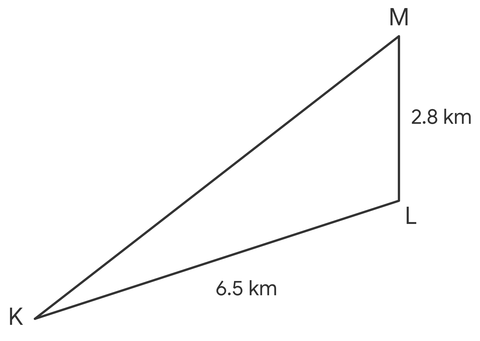
Calculate the bearing of K from L.
Example 2 (calculator)
A boat makes three straight-line journeys:
• It leaves a port A and sails 22 km due north to B.
• It then turns and sails 70 km to C.
• Finally, it sails 85 km back to A.
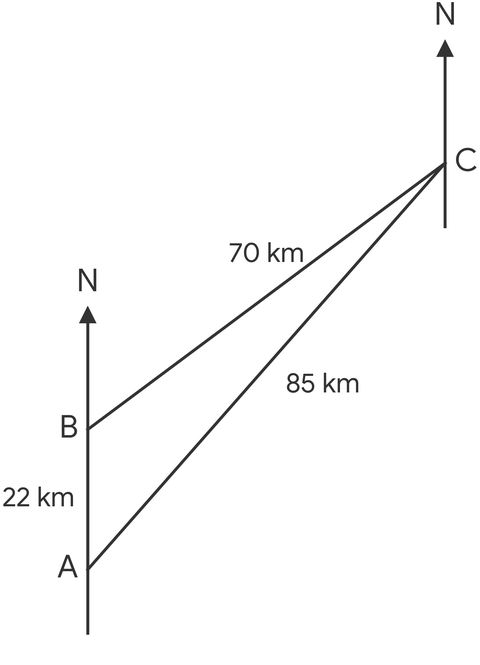
Calculate the bearing of A from C.
Example 3 (calculator)
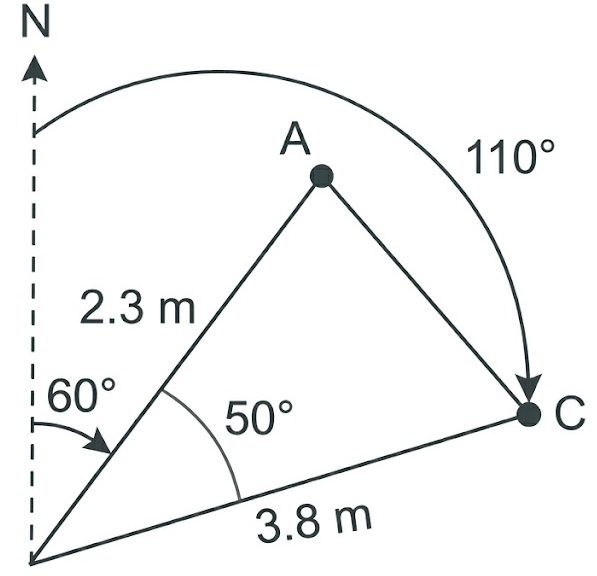
Alan and Claire are in their garden, thinking about some possible improvements to its layout.
They stand back-to-back and then walk in different straight-line directions from the same starting point.
Alan walks 2.3 metres on a bearing of 060°. Claire walks 3.8 metres on a bearing of 110°.
How far apart are Alan and Claire now?
Example 4 (calculator)
SQA N5 Maths 2014 P2 Q10 [3,2 marks]
In a race, boats sail round three buoys represented by A, B, and C in the diagram below.

B is 8 kilometres from A on a bearing of 060°.
C is 11 kilometres from B.
A is 13 kilometres from C.
(a) Calculate the size of angle ABC.
(b) Hence find the size of the shaded angle.
Example 5 (calculator)
SQA National 5 Maths 2015 P2 Q13 [4 marks]
In the diagram below P, Q and R represent the positions of Portlee, Queenstown and Rushton respectively.

Portlee is 25 kilometres due South of Queenstown.
From Portlee, the bearing of Rushton is 072°.
From Queenstown, the bearing of Rushton is 128°.
Calculate the distance between Portlee and Rushton.
Do not use a scale drawing.
Example 6 (calculator)
SQA National 5 Maths 2017 P2 Q10 [4 marks]
In the diagram below D, E and F represent the positions of Dunbridge, Earlsford and Fairtown respectively.

Dunbridge is 15 kilometres west of Earlsford.
From Dunbridge, the bearing of Fairtown is 126°.
From Earlsford the bearing of Fairtown is 230°.
Calculate the distance between Dunbridge and Fairtown.
Do not use a scale drawing.
Example 7 (calculator)
SQA National 5 Maths 2018 P2 Q13 [4 marks]
A ferry and a trawler receive a request for help from a stranded yacht.
On the diagram the points F, T and Y show the positions of the ferry, the trawler and the yacht respectively.

• FY is 7·2 kilometres.
• TY is 5·6 kilometres.
• FT is 10·3 kilometres.
• F is on a bearing of 240° from T.
Calculate the bearing of the yacht from the trawler.
Example 8 (calculator)
SQA National 5 Maths 2021 P2 Q7 [4 marks]
A fishing boat and a yacht left a harbour at the point H.
The fishing boat travelled 3.4 kilometres on a bearing of 047° to the point F.
The yacht travelled 5.7 kilometres on a bearing of 115° to the point Y.
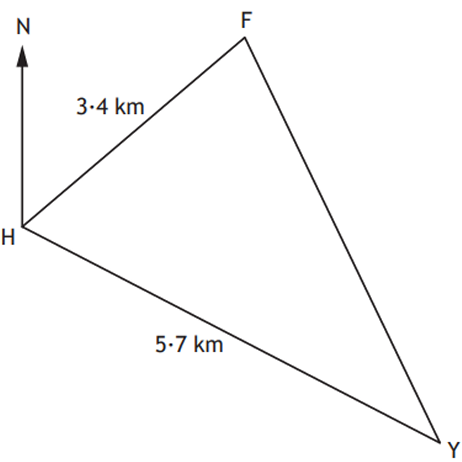
Calculate the distance between the fishing boat at F and the yacht at Y.
Example 9 (calculator)
SQA National 5 Maths 2025 P2 Q12 [4 marks]
In the diagram A, B and C represent the positions of three checkpoints in an orienteering course.
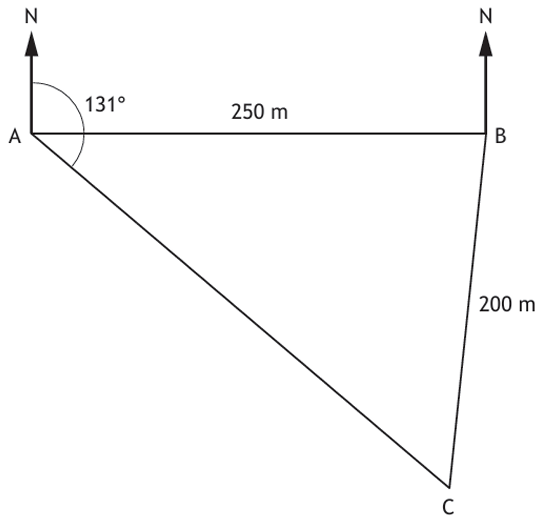
• B is 250 metres east of A.
• The bearing of C from A is 131°.
• C is 200 metres from B.
Calculate the bearing of C from B.
Do not use a scale drawing.
Need a tutor for N5 Maths?

Try our free, no-obligation tutor search tool.
Click here to find a tutor in your area.
If this message continues to display, please refresh the page.
Buy N5 Maths practice papers
Zeta: Five Practice Papers TOP CHOICECGP: N5 Maths Exam Practice
Leckie: Revision and Practice
Hodder: N5 Maths Practice Papers
Past paper questions
| • All past paper questions by topic |
|
• 2014 Paper 2 Q10 (with cosine rule) • 2015 Paper 2 Q13 (with sine rule) • 2017 Spec. P2 Q15 (with sine rule) • 2017 Paper 2 Q10 (with sine rule) • 2018 Paper 2 Q13 (with cosine rule) • 2021 Paper 2 Q7 (with cosine rule) • 2025 Paper 2 Q12 (with sine rule) |
| Standard Grade: Credit (1986–2013) • Exam questions and answers • More exam questions and answers |
| Intermediate 2 (2000–2015) • Triangle trigonometry (with answers) |
Buy our favourite N5 textbook
Zeta National 5+ Maths
Clear and comprehensive.
Progressive exercises.
Includes answers.
Buy from Zeta Press
Bearings worksheets
| D R Turnbull - worksheet • Bearings (with solutions) |
| Inverclyde Academy worksheet • Bearings (no answers) |
| Larkhall Academy exercises • Pages 12-14 Ex 8 (no answers) |
Buy N5 Maths revision guides
How to Pass N5 Maths TOP CHOICEBrightRED: N5 Maths Study Guide
CGP: N5 Maths Revision Guide
Notes and videos
| Videos - Maths180.com |
| Video - Mr Graham Maths |
| Video - YouKenMaths |
| Notes and videos - Mistercorzi |
| Notes - National5.com |
| Worked examples - Maths Mutt |
| • Revision notes - BBC Bitesize • Test yourself - BBC Bitesize |

Click here to study the bearings notes on National5.com.
You may also want to check out their Nat 5 Maths self-study course. We think it's excellent. If you decide to enrol, just use coupon code "Maths.scot" to get £10 discount.